What is most important? Should my top website goal be a wide variety or a highly cohesive selection of images? And how do I know when I’m pushing the boundaries too far?
A:
Fast-track answer: “cohesive-variety”
Need-to-streamline: Too many looks/vibes no longer define your vision; anyone can do what you do.
Sales result: Impactful/consistent websites are remembered. That is our goal – get them to put us on their “list.”
I feel like I’ve hit a wall with my business. I’m bidding on some jobs, but I’m not getting them. Clients want to get a crazy amount of images per day, and the budgets have shrunk. I’m struggling to stay on top of my game. Advice?
A:
As business owners, we all must expect highs and lows. I have seen this happen with ALL photographers.
1. You aren’t alone, and this is normal.
2. What will make it or break it is your response to this.
We chose to get into an industry built on ever-changing creativity, requiring our business plan to proceed in the same growth pattern. Instead of reading this as a bad sign, take this lull as an invitation to change it up.
Is it true that you shouldn’t be looking for a rep until you’re so busy that you can’t handle the backend work yourself, or can you reach out to them when you’ve switched genres or are still growing?
A:
Rep support can cover different needs, as we are all different. I personally enjoy diving into understanding the artist and what they need to up their creative level, always growing to achieve more success. No rule on when a rep is right for you, as it may be more about meeting the right rep for your professional growth patterns.
What would I put as a line item on my invoice for hourly random admin things? This came up recently when I had a client send me so many pages of documents to fill out; they’re also calling me and winding up in calls for hours, and having me send proofs in multiple different ways. I want to bill for that time since it’s excessive, but I don’t know what to call it. I would love any insight you have!
A:
Every bid I do has prep days to cover admin organizational time. I’ve even put an in-person pre-production meeting line item in the bid with a $0 amount to show that our prep time is not free.
It’s good to spell out your terms with all the specifics, as far as which tasks are covered by your prep days, so if they want to add more, it’s clear they will pay more.
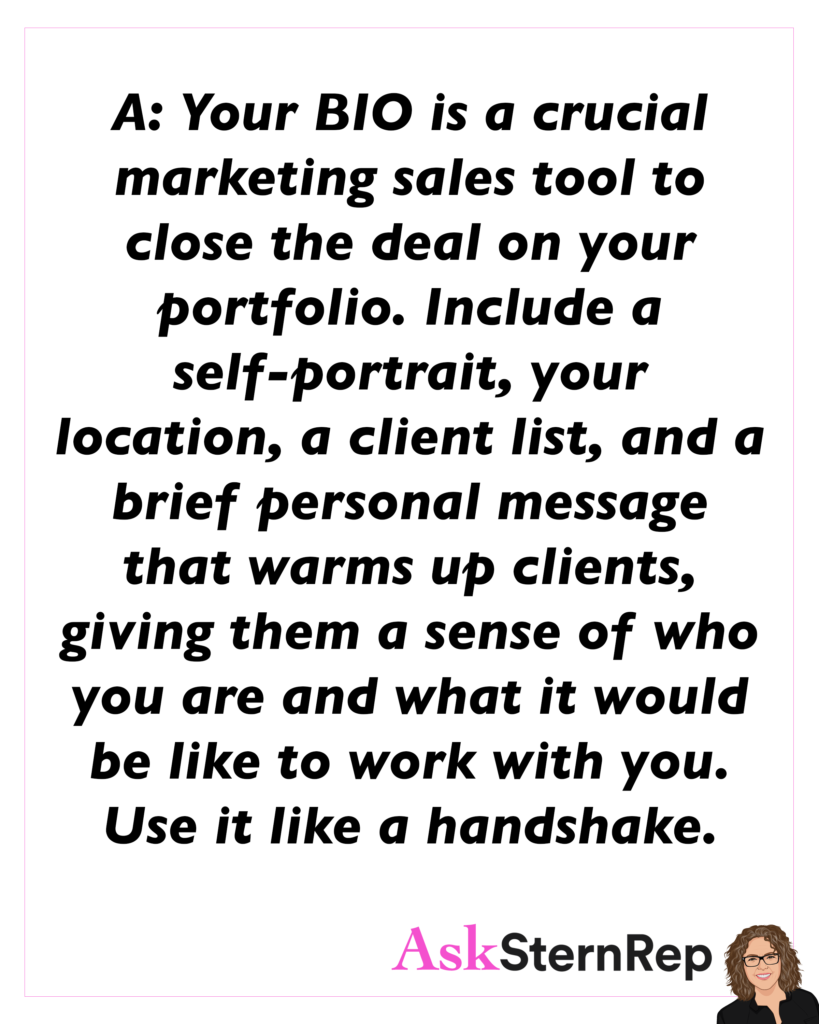
Your BIO is a crucial marketing sales tool to close the deal on your portfolio. Include a self-portrait, your location, a client list, and a brief personal message that warms up clients, giving them a sense of who you are and what it would be like to work with you. Use it like a handshake.
How do you negotiate licensing or ask a client to stop using your photos when there was no contract in place at booking and/or during delivery of images?
A:
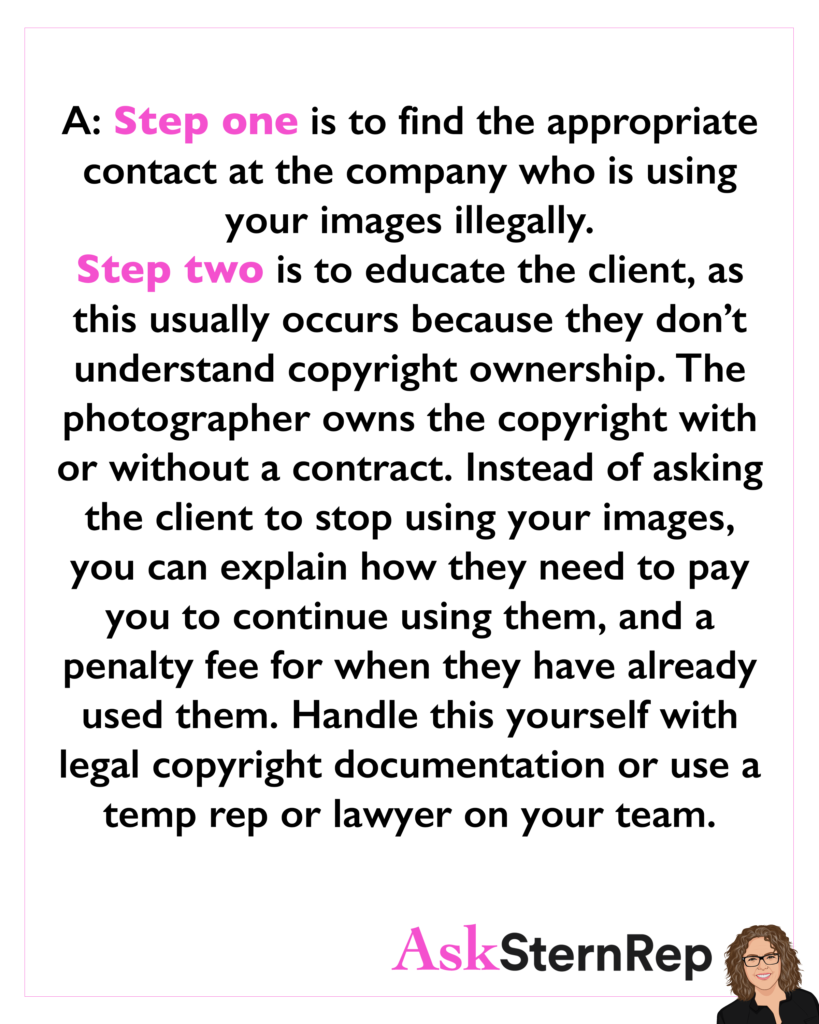
Step one is to find the appropriate contact at the company who is using your images illegally. Step two is to educate the client, as this usually occurs because they don’t understand copyright ownership. The photographer owns the copyright with or without a contract. Instead of asking the client to stop using your images, you can explain how they need to pay you to continue using them, and a penalty fee for when they have already used them. Handle this yourself with legal copyright documentation or use a temp rep or lawyer on your team.
I quoted a project, but didn’t get it after 1 round of quote revisions, with the explanation they are going with someone cheaper. I asked if this was based solely on cost or also on creative style, and whether they would share who they chose, but they didn’t say who they hired. I think I didn’t scope the job properly, misunderstanding the importance of their tight budget. How do we ask for feedback on a job we didn’t land? How do we get the answers we need to quote better next time?
A:
Ways I’ve gotten the most INFO back from clients after not getting the job:
• Asking during a one-on-one in-person meeting or on the old-school telephone.
• Putting forth a close-ended, fully loaded question, allowing them to answer “yes or no.”
• Sharing new, inspired ideas, new thoughts for next time, to intrigue them to use you, like how you will do this with a lower budget.
• Don’t ask right away; give them at least a week or two for it to become official.
• Explain truthfully why you are asking and what you want to learn from it.
What should you charge for the creative concepting fee? Is it based on a % of the creative fee? Overall budget?
A:
I base the creative concepting fee on the amount of time it will take you. It is ultimately the same equation as the shoot rate of the creative fee minus the usage amount. Of course, this is adjustable to fit into your budget, as there is no absolute structured fee for this, but my approach is time + stand-alone talent = money.
What can I do if I’m not happy with my USA representation? I respect my agent, but it isn’t happening. Basically, nothing has come out of it after 2 years, so I’m thinking of going with another agent if I can. Am I greedy? Am I impatient? How do I handle this fragile issue to make this change?
A:
Agents and image creators have equal team-playing responsibilities to find success together, but it truly takes both sides. I’m an agent, and we do our “sales,” which, of course, depends on the sales content we are provided. Is your agent getting your work in front of the right clients? How are the others on your agent’s list doing? Do you like your agent? Does your agent’s vibe inspire you to do your best? Are they available to you? Are they active on social media? These are some of the questions I’d ask myself if I were you.
What does it mean when a client wants me to bid on a project, but they don’t want to have a creative call?
A:
If clients don’t want a creative call, that may be a sign for us to read into how they are not taking this as seriously as we’d like. It is time for the photographer to share their vision and approach, introducing the director with whom you will be on set. I read into them skipping this stage in a couple of ways: You may be the 3rd bidder and not be high on their list for this project, so you should kick butt on your treatment, as that can serve as your intro to the creatives and the client. Your estimate should be as ethically conservative as safely possible to entice the client to choose you, but remember, you could get locked into these prices in the future. This project may not be happening yet, and they need your numbers to provide the client with a preliminary budget range.