Clients

Decision Making of Selecting a Photographer

Q:

How much influence do art directors have in the decision making process of selecting a photographer for a project?

A:

The decision-making process of selecting the photographer goes through many twists and turns, mostly involving the producer, creatives (art director/creative directors or designers), and the clients. The producers usually bring in the selection of photographers for the creatives to choose their top 3. The creatives will then inform the producer who is their top choice. Our goal is always to be the ‘recommend’ to the client, but ultimately, the client decides.

Social Media Analytics

Q:

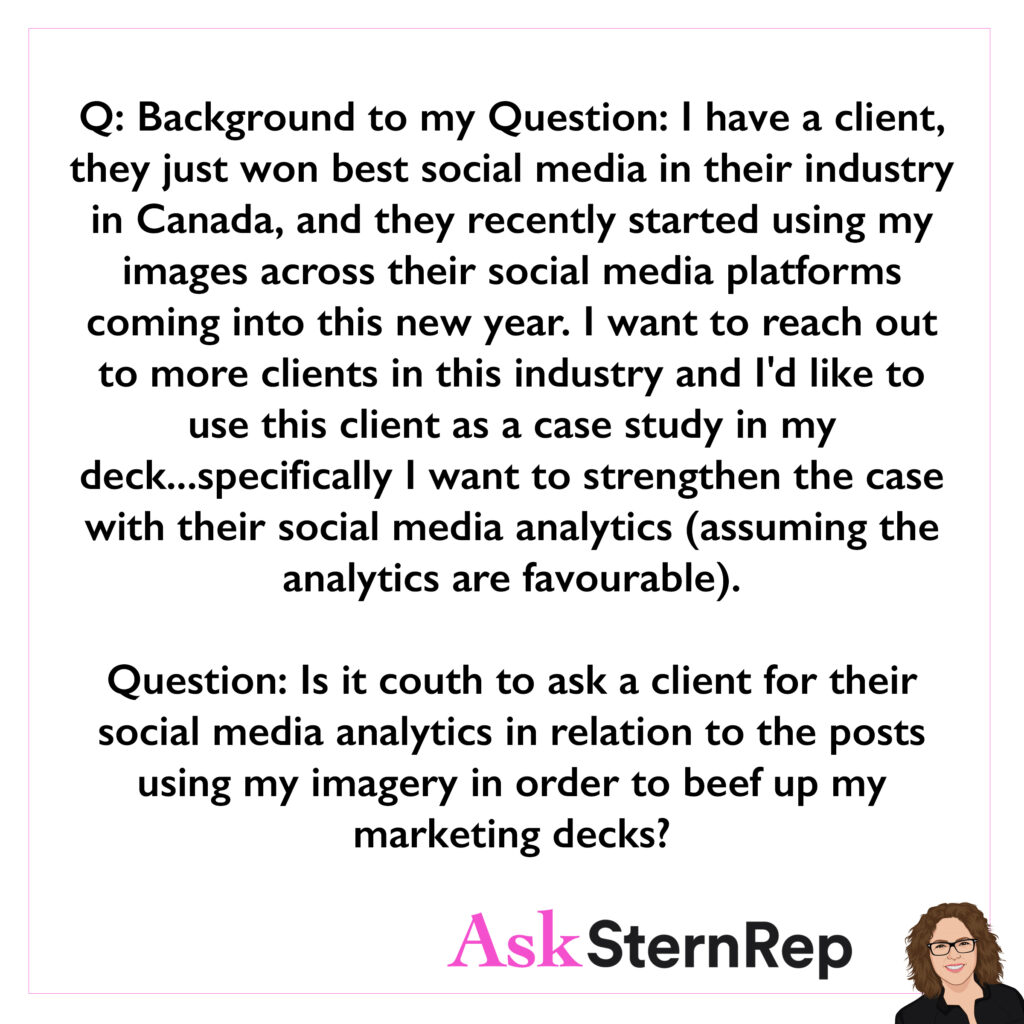
Background to my Question: I have a client, they just won best social media in their industry in Canada, and they recently started using my images across their social media platforms coming into this new year. I want to reach out to more clients in this industry and I’d like to use this client as a case study in my deck… specifically I want to strengthen the case with their social media analytics (assuming the analytics are favourable).

Question: Is it couth to ask a client for their social media analytics in relation to the posts using my imagery in order to beef up my marketing decks?

A:

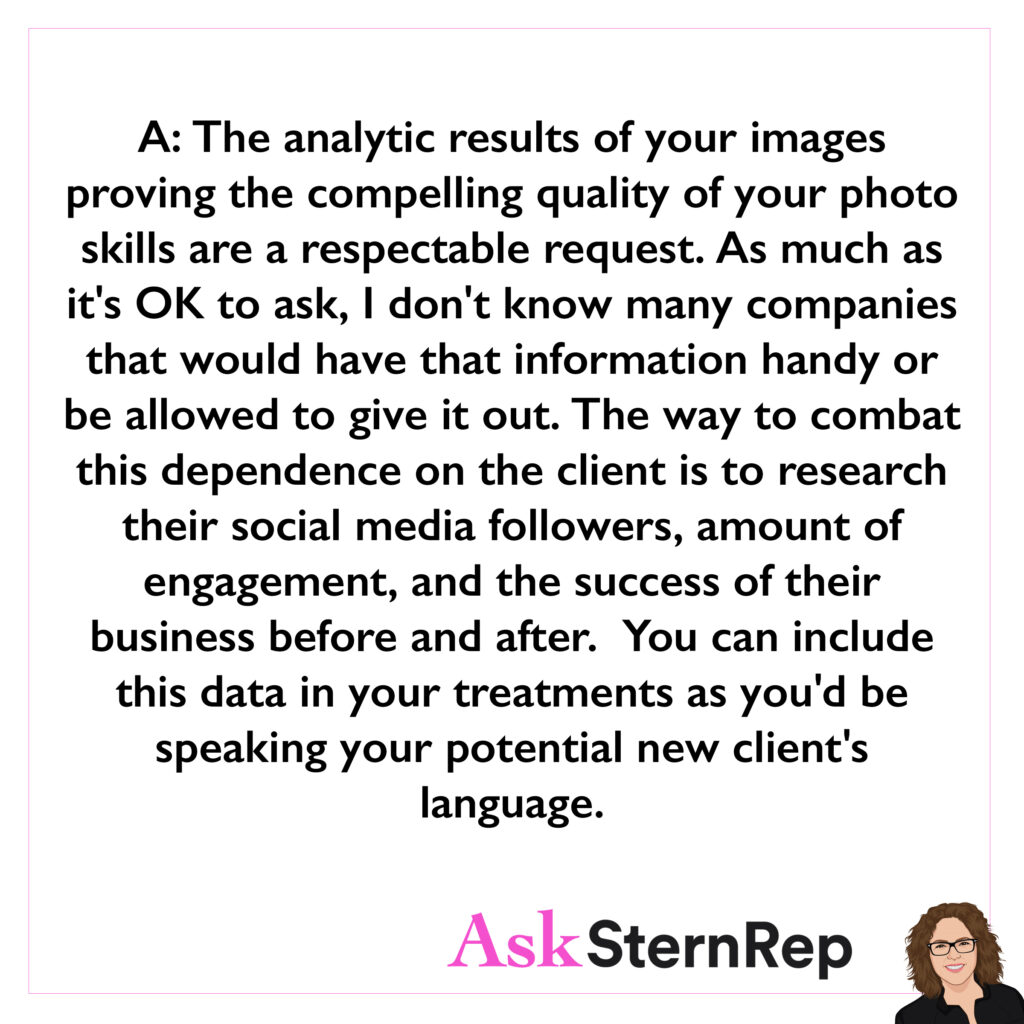
The analytic results of your images proving the compelling quality of your photo skills are a respectable request. As much as it’s OK to ask, I don’t know many companies that would have that information handy or be allowed to give it out. The way to combat this dependence on the client is to research their social media followers, amount of engagement, and the success of their business before and after. You can include this data in your treatments as you’d be speaking your potential new client’s language.

Project Minimum

Q:

Hi Andrea! I have a question regarding one-sheets that maybe might be helpful for the community. Would you suggest including a project minimum? I’ve been getting a lot of requests for “rate cards” and I usually say it’s project dependent.

A:

Photographer’s rates depend on the type of work you do. If you can simplify this request with a rate card, it would save you time. My goal as the agent is to save time by quickly finding out if we should continue this conversation by quoting a price range. I’ll say, “Our day rate fee for this would usually be somewhere between 4,000 – 10,000, depending on many factors like shot count, shot list, day count, the creative component of the images, and what the licensed usage rights are. What is your budget?” I find a price range to be the fastest way to get to the next step.

Wait and Spread Out Your Commmunication

Quick sales tip that you may not have thought of is to wait and spread out your communication with a client. If it’s not a pressing production matter, use your response/question/personal note as a way of staying on their mind for a longer period of time.

Here’s a sales and marketing tip you might not have considered: I often don’t respond to clients immediately. While sometimes prompt responses are necessary, if it’s a personal matter or if you have a question for them and you’ve just been in touch, try to delay your response as long as possible. The goal is to stay on their mind and remain visible. Use your email communication strategically to keep yourself in their thoughts for a longer period.

Major Bid + Huge Production

Q:

Hello! I have a question. My producer and I did a major bid for the product launch using many models, it involved a huge production of set building, and various teams for what they asked for. We ended up not getting the project, it was nothing that was asked of us as far as production, sets and look. Is there a way to approach the agency when bidding that allows us to be bidding the same job – apples for apples?

A:

While we can’t predict or control the bidding process, we can ask every question to help us understand the production details. The key is to have an A+ producer and make sure you get on a creative call, as that is where we get our answers. The purpose of three-way bidding is to protect clients in a fair apple to apple comparison, so they are not overpaying. Our goal is to protect ourselves by understanding all the information, even when we may have to dig around to get that info.

Don’t Hold Back in Stating Your Case

Clients don’t always have all the facts when we are bidding a job, leading us to under-bid certain areas. If more responsibility falls into your lap than expected, don’t hold back in stating your case to request more $. Clients know that some gray areas may result in an overage, but they need us to be the ones to ask for it.

Sometimes we bid on projects where we don’t have all the information yet, and the client may not have all the details either, leading to many assumptions. We should include “TBD” (to be determined) on those line items in our bid to protect ourselves. Even if we don’t include them, once the job is awarded and more responsibilities shift to us that were initially thought to be handled by the client, don’t hesitate to ask for additional funds. Address any new needs or changes directly with the client—don’t get frustrated. Often, they will understand because the situation was unknown at the time. Request more prep days, additional tech scout days if needed, extra post time, or anything else necessary. Remember, just because the bid is awarded doesn’t mean you have to absorb these changes without discussing them.

Testing Rate

Q:

Hey there, I had a meeting today with a client that I would really like to work with. The meeting went great but they asked what my test rate is and I’m kind of at a loss. Any suggestions on pricing a test would be greatly appreciated.

A:

A test rate usually falls within half of what the regular day rate can be for a client. The logic behind the test rate is how it does not include usage licensing fees. This principle is the same premise for how I price a pre-light day; always have the estimate read, “no usage included” next to this fee.

Choose Your Words Wisely

Admit it; you are SELLING a product. Approach the conversations with a potential client as a LISTENER, ready to open the pathway to let your true purpose be heard. Choose your words wisely instead of filling any space. Trust me; there won’t be much empty space.

Spec Work

Q:

In the directing world, spec work is a way to break in. In photography, would you recommend photographing specific brands on spec to build your portfolio, or using no brands whatsoever?

A:

In the photo world, clients want to see your overall style match their brand. Build your portfolio to show the look and feel your favorite clients cater to, and use this “spec” concept to incorporate the products your ideal clients will need to see. If you want to get beer campaigns, put in some cans or bottles and show off how your shiny condensation skills fit your cohesive vibe. Displaying the type of product is more important than the specific brand of the product.

Bring the Client’s Branding into Your Bidding

Bring the client’s BRANDING into your bidding approach as much as possible. Do your research, ask the questions, as the ultimate purpose of receiving the job is to achieve your client’s branding goals.

When we’re in the process of getting a job, there’s a lot of times where we can focus on the branding for the client. We need to make sure a lot of what we are working around is their branding because that is what’s most important to them. Do your research to find out what their brand is. Check out their website. If they don’t make it clear what the feeling/color/ tone is then ask about it and make sure you mention it in your treatment. Because that’s what they want to hear. They want to know that you’re a part of it. You’re not just a part of this one shoot, you’re part of their long term vision.